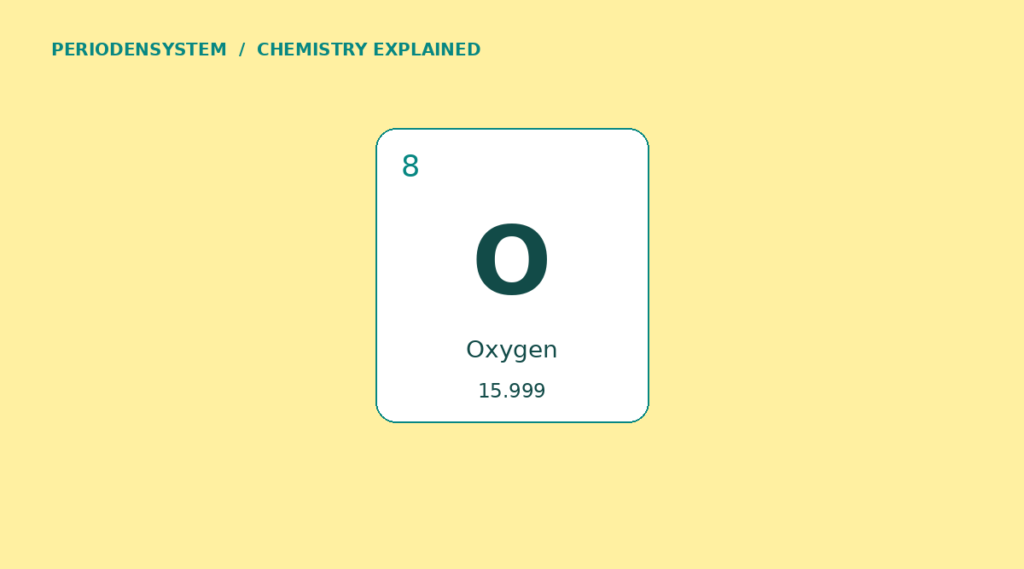
Start with oxygen. Its box usually contains the symbol O, the number 8 and a decimal close to 15.999. Those three entries answer different questions: which element is this, how many protons does it have, and what mass value is useful for an ordinary sample? Reading them as interchangeable numbers is where many early mistakes begin.
The periodic table becomes easier to use when you treat it as an organized reference rather than a wall of facts to memorize. First read a box. Then read its row and column. Finally, ask what the position lets you predict—and what it leaves undecided.
Read the symbol before the numbers
An element symbol begins with a capital letter. A second letter, when present, is lowercase. Co is cobalt; CO is a formula containing carbon and oxygen. That tiny change in capitalization changes the meaning completely.
Not every symbol resembles the modern English name. Sodium is Na, potassium is K and iron is Fe. Use the element name printed in the box when a symbol is unfamiliar. Guessing from the first letter works often enough to become a bad habit.
A box represents an element, not necessarily the form in which that element exists in a sample. The oxygen box uses O, while ordinary molecular oxygen is O2. The table identifies the atom type; a chemical formula describes how atoms occur together.
The atomic number fixes the element’s identity
The atomic number, Z, counts protons. Oxygen has eight protons, sodium has eleven and calcium has twenty. Changing that count changes the element. Removing an electron does not: Na and Na+ are both sodium.
For a neutral atom, the electron count equals Z. Thus a neutral calcium atom has twenty electrons. A calcium ion with charge 2+ has eighteen. Keep the word “neutral” in the rule; otherwise it gives the wrong answer for ions.
The modern table runs in order of increasing atomic number. Atomic weights mostly rise in the same direction, but not perfectly. Position is not assigned by whichever decimal is larger. The IUPAC periodic-table reference is useful for checking accepted names, symbols and the meaning of bracketed entries.
The decimal is not a neutron count
In many classroom tables, the decimal is a rounded standard atomic weight. It reflects isotopic composition in normal terrestrial material. Tables sometimes label a related average mass in atomic mass units, u. Relative atomic weight itself is dimensionless; an average mass expressed in u is a quantity with a unit.
Neither quantity is the mass number of a particular isotope. Chlorine’s familiar value near 35.45 does not describe a nucleus containing a fractional neutron. It is a sample-level average. To find neutrons in chlorine-37, use the isotope’s mass number: 37 − 17 = 20.
Some elements have an interval rather than one standard atomic-weight value because natural isotopic proportions vary. For elements without a characteristic natural isotopic composition, a table may show a selected isotope’s integer mass number in square brackets. Check the legend rather than treating brackets as decimal rounding. IUPAC’s elements-and-isotopes reference explains these distinctions.
Rows are periods; columns are groups
A horizontal row is a period. A vertical column is a group. The familiar long-form table has seven periods and eighteen numbered groups. Sodium is in period 3, group 1; chlorine is in period 3, group 17.
Elements in a group often show related chemistry because their outer-electron arrangements have similarities. Group 1 metals commonly form 1+ ions, and group 17 elements commonly form 1− ions in simple binary ionic compounds. These are useful patterns, not promises covering every compound.
For main-group elements, group position helps you infer the usual valence-electron count: groups 1 and 2 have one and two; groups 13–18 generally have three through eight. Helium is the important group-18 exception with two. Applying this shortcut unchanged to transition metals produces errors.
A neutral sodium atom can be described by a 2,8,1 shell arrangement, placing its outer occupied shell at n = 3. Its period is therefore consistent with the electron arrangement. More detailed configurations are needed once the d and f subshells enter the picture.
What the separated lower rows are doing
The two rows often printed below the main table are a space-saving layout choice. The lanthanoid and actinoid series belong within periods 6 and 7; they are not additional periods 8 and 9.
Imagine sliding those rows into the main body. The chart becomes much wider, but the atomic-number sequence remains continuous. Remembering this prevents a common reading mistake: jumping from barium directly to hafnium as though the intervening elements had disappeared.
You may also encounter different presentations of group 3 and the start or end of the detached rows. For an introductory task, follow the supplied table’s labels and avoid assuming every layout must use identical boundary choices.
Colors and category labels depend on the table
A colored box might indicate a chemical family, whether the element is a metal, or its physical state at a selected temperature. There is no universal color code. Read the legend before concluding that all blue boxes are gases.
State labels also need conditions. A chart describing room-temperature states is answering a different question from an interactive table set to a much higher temperature. If a property seems surprising, check the temperature control and the units first.
The broad metal–nonmetal division is useful, but the “metalloid” boundary is not a single universally fixed list. Categories summarize behavior; they do not replace the actual property you need to know.
A three-element walkthrough
Oxygen: O, Z = 8, period 2, group 16. A neutral atom has eight electrons. Oxygen-18 has ten neutrons. Nothing in the rounded average mass alone tells you that a particular atom is oxygen-18.
Sodium: Na, Z = 11, period 3, group 1. Neutral sodium has eleven electrons; Na+ has ten. Its proton count stays eleven in both cases. The 1+ charge belongs to the ion, not to the element’s box as a permanent label.
Calcium: Ca, Z = 20, period 4, group 2. Calcium-40 has twenty neutrons. Ca2+ has eighteen electrons. The numerical coincidence that both the proton and neutron counts are twenty belongs to that isotope, not to every calcium atom.
Use the position to ask better questions
Suppose an exercise asks which is larger, sodium or chlorine. They share a period, so the general left-to-right decrease in atomic size is relevant. Suppose instead it asks the exact boiling point of a compound containing chlorine. A position-based shortcut cannot supply that answer.
The table organizes evidence and supports predictions. It does not encode every substance’s structure, solubility or reaction conditions. Use the interactive periodic table to locate an element, then open its reference page for a property with units and conditions.
Try reading a box without looking at the name
A hypothetical exercise gives you Z = 12, period 3 and group 2. The element is magnesium. A neutral atom has twelve electrons. If the isotope is magnesium-25, it has thirteen neutrons; if the ion is Mg2+, it has ten electrons. Each answer uses a different part of the information.
That is a good final check on your method: identity from proton count, neutron count from an isotope label, electron count from charge. If one number is doing all three jobs, stop and separate the questions.
Next read atomic number, mass number and atomic mass, or compare oxygen’s element reference with its neighbors.
References and further reading
- OpenStax Chemistry 2e: The Periodic Table—organization and broad categories.
- IUPAC: Periodic Table of Elements—names, symbols and table conventions.
- IUPAC: Periodic Table of the Elements and Isotopes—isotopic composition and atomic-weight displays.
- OpenStax: Chemical Formulas—symbols versus formulas.
- Royal Society of Chemistry: Interactive Periodic Table—alternative layouts and property views.