Chlorine has atomic number 17, chlorine-37 has mass number 37, and an ordinary periodic table gives chlorine an atomic weight near 35.45. All three values can be correct at once. They describe different things.
The practical difficulty is deciding which number belongs in a calculation. Subtract the wrong value from 17 and you get a fractional neutron count. Treat a 2+ charge as two missing protons and you accidentally turn one element into another. A few clearly separated definitions prevent both mistakes.
Atomic number: count the protons first
The atomic number, written Z, is the number of protons in a nucleus. It identifies the element. Carbon always has six protons; magnesium always has twelve. A particle with thirteen protons is aluminum, whatever its electron count happens to be.
For a neutral atom, positive and negative charges balance, so electrons = protons = Z. An ion needs a second step because it has gained or lost electrons. The nucleus retains the same atomic number during ordinary ion formation.
Use a small working table when several species appear in one question. Put Z in a proton column immediately. It is the fixed anchor from which the neutron and electron counts can be worked out independently.
Mass number: count the particles in one nucleus
The mass number, A, adds protons and neutrons:
A = number of protons + number of neutrons.
Rearranging gives neutrons = A − Z. Mass number is a whole-number count. It is not a mass measured in grams, and it is not the average printed for a natural sample.
For silicon-29, Z = 14 and A = 29. The nucleus therefore contains fourteen protons and fifteen neutrons. Silicon-28 has the same fourteen protons and fourteen neutrons. The different neutron counts make these different isotopes of silicon.
You cannot calculate the neutron count of an unspecified silicon atom exactly by rounding the periodic-table entry. That rounding may happen to select a common isotope, but it does not establish which isotope the question means.
Read isotope notation one part at a time
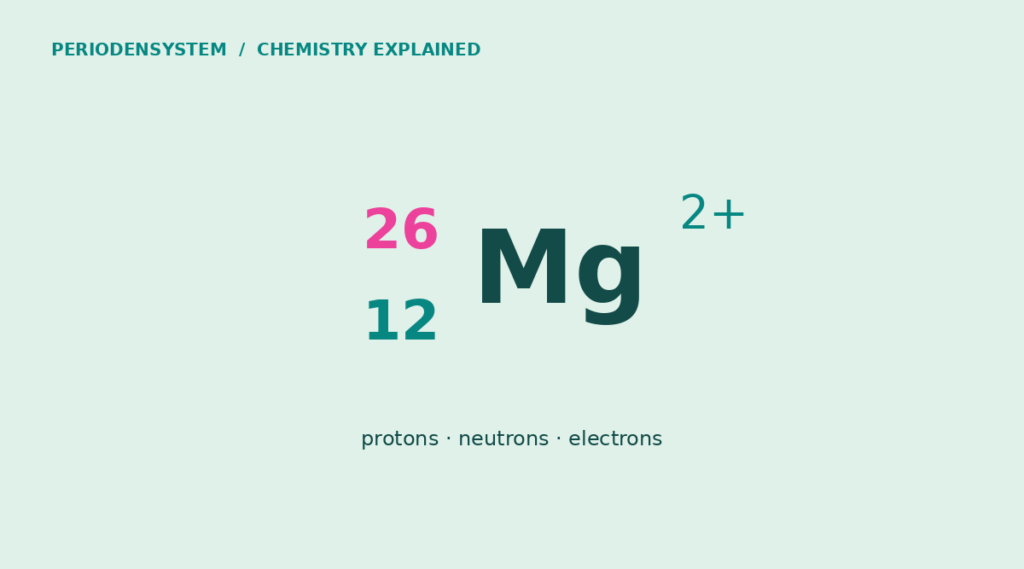
In full nuclear notation, the mass number appears at the upper left of the symbol and the atomic number at the lower left. Charge, if shown, goes at the upper right. In ordinary text, names such as magnesium-26 are often easier to read.
Take 2612Mg2+. The lower-left 12 gives twelve protons. The upper-left 26 gives twenty-six nucleons in total, so there are fourteen neutrons. Finally, the 2+ charge means two fewer electrons than the neutral atom: ten electrons.
Do not subtract the charge from the neutron count. The notation contains three separate instructions. Reading them in the order proton count, neutron count, electron count makes the bookkeeping much less fragile.
Atomic mass is an actual mass
The mass of an atom can be expressed in the unified atomic mass unit, u, also called the dalton, Da. The reference is one twelfth of the mass of a free carbon-12 atom at rest in its ground state. Carbon-12 has atomic mass exactly 12 u by this definition.
An isotope’s atomic mass is generally not exactly its mass number in u. Neutrons and protons do not each weigh exactly 1 u, electrons contribute a little mass, and binding energy changes the mass of the bound system. You do not need nuclear calculations to remember the distinction: A counts; atomic mass measures.
The IUPAC atomic-mass entry and relative atomic-mass entry keep the mass quantity separate from its dimensionless ratio.
Why the periodic-table value is usually a decimal
A sample of an element may contain several isotopes. Its average atomic mass depends on how much of each isotope is present. More abundant isotopes contribute more strongly to the average.
Here is an invented two-isotope example, deliberately using rounded teaching values. Suppose 70% of the atoms have mass 20.0 u and 30% have mass 22.0 u. The average is:
(0.70 × 20.0 u) + (0.30 × 22.0 u) = 20.6 u.
No atom in that invented sample needs to weigh 20.6 u. The number describes the collection. A ten-atom picture makes this visible: seven atoms contribute 140.0 u and three contribute 66.0 u; 206.0 u divided by ten atoms gives 20.6 u per atom.
Using 70 and 30 without dividing by 100 would make the answer a hundred times too large. Using a simple midpoint, 21.0 u, would silently assume equal isotope abundances. Neither method matches the stated sample.
Atomic weight, average mass and standard values
Relative atomic mass, Ar, compares an average atomic mass with u. As a ratio, it has no unit. An average atomic mass of 20.6 u corresponds to a relative atomic mass of 20.6.
Standard atomic weights are recommended values applicable to normal materials. For some elements, natural isotope variation is large enough that the recommendation is an interval. An abridged table gives convenient rounded values with stated uncertainties. These are reference choices, not evidence that isotope composition never changes.
A sample enriched in one isotope can have a different average from the standard value. If a problem supplies isotope abundances or a sample-specific average, use that information rather than replacing it with a familiar periodic-table decimal.
A complete particle-count example
Consider three species: neutral sulfur-34, S2− made from sulfur-34, and neutral phosphorus-31.
| Species | Protons | Neutrons | Electrons |
|---|---|---|---|
| Sulfur-34 | 16 | 18 | 16 |
| Sulfur-34, 2− | 16 | 18 | 18 |
| Phosphorus-31 | 15 | 16 | 15 |
The first two entries have identical nuclei. The ion has two additional electrons. The third entry changes the proton count and therefore changes the element. Writing the answers side by side helps expose which operation affects which quantity.
You can also check charge backwards. Sixteen protons and eighteen electrons produce a net charge of 2−. If your proposed sulfur ion has fourteen electrons but a 2− label, the sign has been reversed.
What information is missing?
“How many neutrons does copper have?” is incomplete unless an isotope or a specified averaging task is given. Copper-63 and copper-65 have different neutron counts. A standard atomic weight does not choose one atom for you.
“How many electrons does an atom with Z = 13 have?” also needs the charge or the statement that it is neutral. A neutral aluminum atom has thirteen; Al3+ has ten. Asking what is missing is part of solving the problem, not an excuse to avoid it.
Practice: work from the labels
Question 1: How many neutrons are in potassium-41? Potassium has Z = 19, so 41 − 19 = 22 neutrons.
Question 2: How many electrons are in potassium-41 as K+? Eighteen. The isotope label changes the neutron calculation; the ion charge changes the electron calculation.
Question 3: Is an atom with twenty protons and twenty-two neutrons potassium? No. Twenty protons identify calcium; its mass number is 42.
For calculations involving a macroscopic sample, continue to molar mass. For locating Z and reading the table legend, use the periodic-table walkthrough.
References and further reading
- OpenStax: Atomic Structure and Symbolism—nuclear notation and isotope averages.
- IUPAC: Atomic number.
- IUPAC: Mass number.
- IUPAC: Atomic mass.
- IUPAC: Relative atomic mass.
- CIAAW: Abridged Standard Atomic Weights—recommended values and uncertainties.