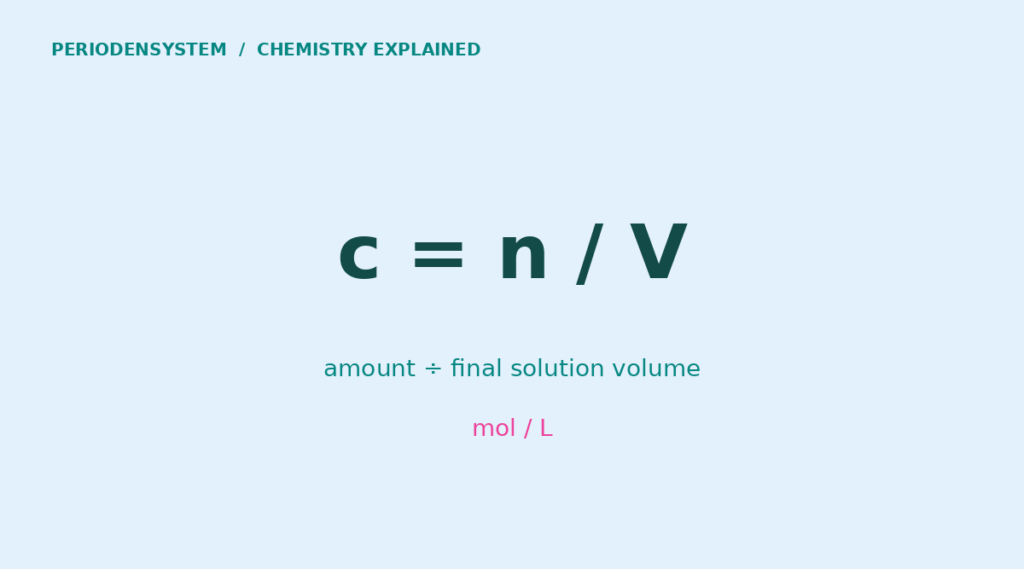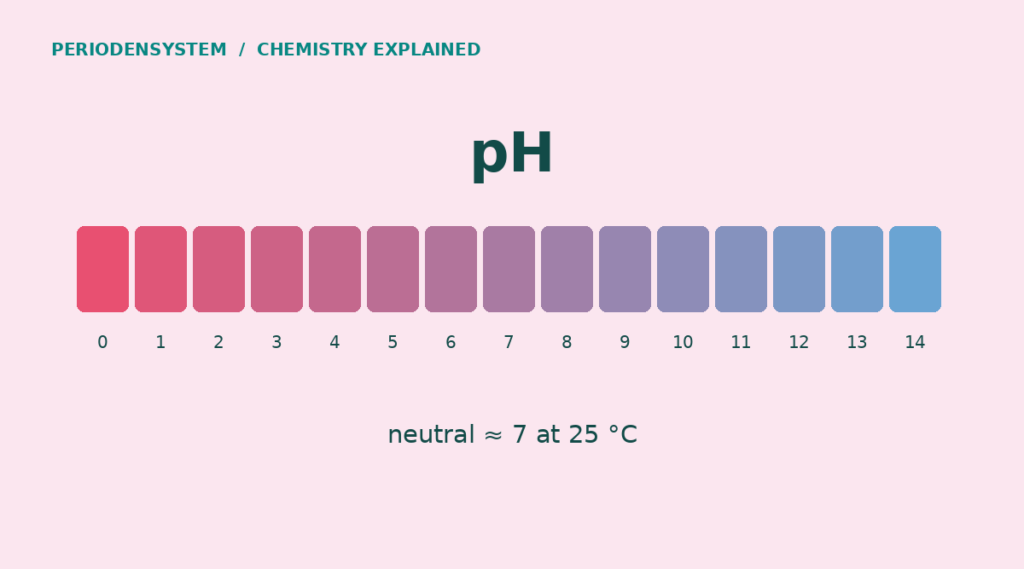
A solution at pH 3 and one at pH 5 are separated by two units on the scale. That does not mean the first contains “two more units of acid.” Under the usual dilute-solution approximation, its hydronium concentration is one hundred times greater.
pH combines acid–base chemistry with logarithms. Understanding both parts prevents several misleading shortcuts: that all acids are strong, that concentrated and strong mean the same thing, or that neutral always means pH 7 under every condition.
Acids and bases describe proton transfer
In the Brønsted–Lowry model, an acid donates a proton and a base accepts one. The labels describe roles in a reaction. Water can accept a proton from an acid or donate one to a base.
For hydrogen chloride in water, the usual equation is:
HCl + H2O → H3O+ + Cl−.
HCl acts as the acid and water as the base. H3O+ is the conjugate acid of water; Cl− is the conjugate base of HCl. A conjugate pair differs by one proton, not by an arbitrarily chosen oxygen atom or electron.
Ammonia provides the reverse role for water: NH3 + H2O ⇌ NH4+ + OH−. Ammonia accepts a proton, so it is a base even though its formula does not contain OH.
What pH measures, and the approximation used here
The formal definition uses hydrogen-ion activity: pH = −log10a(H+). Activity accounts for how a species behaves in a real solution, including interactions that concentration alone does not capture.
In introductory dilute-solution calculations, activity is often approximated using concentration relative to the standard concentration. Numerically, this is commonly written pH ≈ −log10[H3O+] when the concentration is entered in mol/L.
That convenient classroom expression is an approximation, not a claim that pH is defined simply by grams of acid per liter. The IUPAC pH definition is the reference for the distinction.
Read the logarithmic scale
If [H3O+] is approximately 10−3 mol/L, the approximate pH is 3. A concentration of 10−5 mol/L corresponds to pH 5.
Divide the two concentrations: 10−3/10−5 = 102 = 100. Lower pH means greater hydrogen-ion activity, and in the stated approximation greater hydronium concentration.
For noninteger values, the same rule works. A difference of 0.50 pH unit corresponds to an activity ratio of 100.50, about 3.16. The pH number is not itself a linear amount to average or subtract as if it were grams.
Charts often show a convenient range from 0 to 14. Those are not absolute mathematical boundaries: pH can fall outside that interval. At high concentrations, however, the simple concentration approximation needs particular care; the activity-based definition remains the reference.
Example 1: calculate pH from concentration
Assume a dilute solution has hydronium concentration 2.50 × 10⁻⁴ mol/L and the activity approximation is appropriate.
pH ≈ −log10(2.50 × 10⁻⁴) = 3.602.
A useful mental check puts the answer between 3 and 4 because the concentration lies between 10−3 and 10−4 mol/L. An answer of −3.602 probably lost the leading minus sign.
For logarithms, concentration significant figures translate into decimal places in the pH value: three significant figures here support three decimal places. This convention should not be confused with ordinary multiplication rules.
Example 2: calculate concentration from pH
For a stated pH of 4.30, reverse the logarithm under the same approximation:
[H3O+] ≈ 10−4.30 mol/L = 5.0 × 10⁻⁵ mol/L.
The two decimal places in 4.30 correspond to two significant figures in the concentration. Enter 10 raised to the negative pH; multiplying 10 by −4.30 is a different operation.
This inferred concentration is not automatically the total analytical concentration of the acid used to make the solution. A weak acid may remain substantially un-ionized, so the amount initially added and the equilibrium hydronium amount need not be the same.
Neutrality is an equality, not a fixed number
A neutral aqueous solution has equal hydrogen-ion and hydroxide-ion activities. At about 25 °C in the usual dilute approximation, Kw is about 1.0 × 10⁻¹⁴, giving equal concentrations near 1.0 × 10⁻⁷ mol/L and neutral pH near 7.00.
Kw depends on temperature. When temperature changes, the neutral pH changes too. A value below 7 does not by itself establish acidity unless the temperature and relevant neutral point are understood.
At a specified temperature, the general relation is pH + pOH = pKw. The familiar numerical sum 14.00 is the approximately 25 °C version, not a universal constant for every water sample under every condition.
Example 3: use pOH with the temperature stated
At 25 °C, assume [OH−] = 4.0 × 10⁻³ mol/L and ideal dilute behavior. Then:
pOH ≈ −log10(4.0 × 10⁻³) = 2.40.
pH ≈ 14.00 − 2.40 = 11.60.
The solution is basic under those conditions. This does not mean it contains no hydronium. Water’s equilibrium relates both ion populations; a very small concentration is still different from an absent species.
Strong is not the same as concentrated
Acid strength concerns the extent of ionization in a specified solvent and is described quantitatively using equilibrium constants. Concentration describes how much substance is present per amount or volume of solution.
A dilute solution of a strong acid and a concentrated solution of a weak acid are both meaningful descriptions. The adjectives answer different questions. Comparing their pH values requires actual concentrations and the relevant equilibrium behavior.
For a simple strong monoprotic acid in a suitable dilute range, hydronium concentration can be close to the stated acid concentration. Do not extend that approximation without checking it to weak acids, very dilute solutions, highly concentrated solutions or every proton of a polyprotic acid.
Why dilution does not always add exactly one pH unit
Tenfold dilution of a strong monoprotic acid can raise pH by approximately one unit where its hydronium concentration tracks its analytical concentration and water’s contribution is negligible.
For a weak acid, dilution changes the ionization equilibrium as well as the analytical concentration. Near neutrality, water’s own contribution matters. Buffers add another case: they resist pH changes over a useful range because a conjugate acid–base pair participates in the response.
Therefore, “divide acid concentration by ten, add one to pH” is a conditional calculation, not a universal dilution rule.
What a pH number cannot tell you
pH alone does not give the total amount of acid available for neutralization, identify every dissolved substance or establish whether a liquid is safe to handle or drink. Two solutions can have similar pH and very different compositions and buffering capacities.
Do not taste or touch an unknown liquid to classify it. For a theoretical problem, use the stated data. For a measurement, use an appropriate calibrated method and the relevant laboratory procedure rather than guessing from appearance.
Practice: compare two values
Compare pH 3.80 and pH 5.30. The difference is 1.50, so the lower-pH solution has 101.50 ≈ 31.6 times the hydrogen-ion activity. Under comparable dilute conditions, the concentration ratio is approximately the same.
For the amount–volume calculations behind these examples, read molarity and dilution. For charge and dissolved species, revisit bonding and solution behavior.
References and further reading
- IUPAC: pH—formal activity definition.
- OpenStax: Brønsted–Lowry Acids and Bases—proton transfer and conjugate pairs.
- OpenStax: pH and pOH—logarithms, water equilibrium and temperature.
- OpenStax: Relative Strengths of Acids and Bases—ionization versus concentration.
- OpenStax: Buffers—why pH response depends on composition.