Salt dissolves in water, sugar can dissolve in water, and a diamond does not behave like either. Calling the first “ionic” and the others “covalent” is a start, but it leaves most of the explanation unfinished.
Bonding models are useful when they connect a particle-level structure with something you can measure: melting, electrical conduction or solubility. They are less useful as a guessing game in which every substance receives a label and the reasoning stops there.
Begin with the structure you are describing
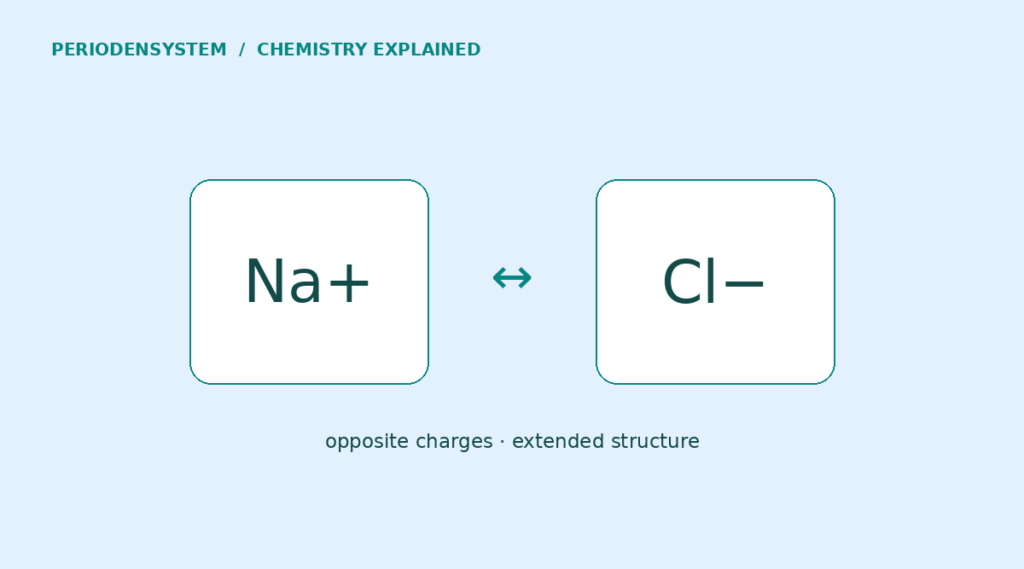
In a simple ionic picture, oppositely charged ions attract in an extended arrangement. Sodium chloride contains Na+ and Cl− ions in a crystal lattice. NaCl expresses their ratio; it does not normally identify isolated NaCl molecules inside that solid.
In a covalent model, atoms share electron density. Two hydrogen atoms can form an H2 molecule with a shared electron pair. Carbon atoms can also form a continuous covalent network, as in diamond. Both involve covalent bonding, but the resulting structures are very different.
That distinction matters immediately: a box of small molecules and one giant network should not be expected to melt or conduct in the same way merely because both are called covalent.
Why the electron-transfer drawing is only part of ionic bonding
Introductory diagrams often show sodium losing an electron and chlorine gaining it. This is a helpful way to account for ion charges and an overall neutral formula. It is not the whole energetic story of making a crystal from its elements.
Removing an electron from an isolated gaseous atom requires energy. Other steps, including the attractions associated with lattice formation, contribute to whether the overall process is favorable. Drawing a transferred dot does not by itself demonstrate that every imaginable metal–nonmetal combination forms a stable salt.
Use the transfer picture to explain the count. Use the extended electrostatic structure to explain why each ion interacts with many neighbors rather than only one partner.
Build formulas by balancing charge
Magnesium commonly forms Mg2+ and chlorine forms Cl− in their simple binary salt. One magnesium ion needs two chloride ions to give zero total charge:
(+2) + 2(−1) = 0, so the formula is MgCl2.
For aluminum oxide, balance Al3+ with O2−. Two aluminum ions contribute +6 and three oxide ions contribute −6. The simplest neutral ratio is Al2O3.
These ratios are derived from specified charges. They do not mean aluminum always has charge 3+ in every context, or that every bond in a real material is perfectly ionic. Charge bookkeeping is a model with a defined purpose.
Covalent bonds can share electrons unequally
In a bond between identical atoms, neither end has a different electronegativity by virtue of being a different element. In a bond between unlike atoms, the electron distribution may be uneven.
A polar covalent bond has partial charges, often marked δ+ and δ−. These are not the same labels as full ionic charges. In an O–H bond, oxygen attracts the bonding electron density more strongly than hydrogen. This does not turn an ordinary water molecule into a separate oxide ion plus two isolated hydrogen ions.
Electronegativity differences help discuss this continuum. Numerical cutoff rules used in a course are rough classification aids. They are not a universal experimental boundary separating every bond into two perfectly distinct boxes.
Bond polarity and molecular polarity ask different questions
A molecule’s overall polarity depends on its three-dimensional arrangement as well as its individual bonds. In linear CO2, the two equal C–O bond dipoles point in opposite directions and cancel by symmetry.
Water is bent. Its bond dipoles do not cancel, so the molecule has a net dipole moment. Writing “contains polar bonds” is therefore insufficient to decide whether an entire molecule is polar.
When answering a comparison, draw or describe the shape first. A list of electronegativity values cannot replace the geometry. This is one reason structural formulas and molecular models add information that a molecular formula alone does not contain.
Why electrical conductivity depends on mobility
Charged particles must be able to move through a material for ordinary electrical conduction. In a solid ionic lattice, ions are held near fixed positions. Melting a suitable ionic material allows ions to move; dissolving a soluble ionic compound can also provide mobile ions.
This does not mean all ionic compounds dissolve readily in water. If very little dissolves, the concentration of mobile ions may be small. Solubility is a separate question with its own energetic balance.
Molecular sugar dissolves without producing a comparable population of ions, so a sugar solution does not conduct like a similarly concentrated solution of a strongly dissociating salt. The distinction is the mobile charged species, not simply whether the liquid looks clear.
The network exception is not a small footnote
Many familiar molecular substances have relatively modest melting or boiling temperatures because separating their molecules does not require breaking every covalent bond inside them. The attractions between molecules matter here.
Diamond and silica show why “covalent means low melting point” is a poor rule. Their extended networks cannot be treated as collections of small, independently moving molecules.
Graphite provides another useful warning. It is a carbon network with a structure and electronic behavior unlike diamond’s, and it can conduct electricity. The word covalent alone does not settle conductivity. You must specify the structure and the available charge carriers.
The OpenStax discussion of solids distinguishes molecular, ionic, metallic and covalent-network materials rather than forcing them into one two-column chart.
Solubility is not a one-word prediction
Dissolution involves separating particles already associated with one another and forming new interactions with the solvent. A useful explanation considers both sides of that process, together with entropy.
“Like dissolves like” is a starting observation, not a quantitative law. It does not tell you exactly how much will dissolve, at what temperature, or whether a reaction accompanies the mixing. Avoid claiming that all ionic compounds are water-soluble or all covalent compounds are insoluble.
Even two solutions with the same dissolved-particle concentration can behave differently if their particles differ in charge or interaction strength. A bonding label narrows the question; it does not answer every property question automatically.
A better way to write an exam explanation
Consider this claim: “Solid sodium chloride does not conduct because it has no charged particles.” The conclusion is familiar, but the explanation is wrong. It contains ions; those ions are not free to migrate through the solid lattice.
A stronger answer identifies the structure, the relevant particles and their mobility. Apply the same habit to a molecular liquid: name the molecules, describe the attractions between them, and explain which process the measurement is probing.
Three quick checks
Is NaCl a molecule in an ordinary salt crystal? The appropriate description is an ionic lattice with a 1:1 formula-unit ratio.
Must a molecule with polar bonds be polar? No. Shape and symmetry determine whether its bond dipoles cancel.
Does “covalent” guarantee poor electrical conduction? No. Graphite is a standard counterexample; the electronic structure must be considered.
For the electron-counting background, read electron configurations. For the distinction between dissolved compounds and solution concentration, continue to molarity and dilution.